Betta Fish Care Guide: Tank Setup, Feeding & Tank Mates
Betta fish are the most misunderstood animal in the aquarium hobby. Sold in cups, marketed as “low maintenance,” and too often kept in unheated bowls — when in reality they’re intelligent tropical fish that thrive for 3-5 years in a proper setup. This complete betta fish care guide covers everything: tank size, water parameters, filtration, feeding, tank mates, and the health problems to watch for.
If you’re setting up your very first tank, start with our complete freshwater aquarium setup guide — the cycling steps there apply to every betta tank. And if you’re still deciding whether a betta is right for you, see how they compare in our roundup of the 15 best freshwater fish for beginners.
Betta Fish at a Glance
- Scientific name: Betta splendens
- Adult size: 2.5-3 inches
- Lifespan: 3-5 years with proper care (often under 1 year in a bowl)
- Minimum tank size: 5 gallons; 10 gallons strongly recommended
- Water temperature: 76-82°F (heater required)
- pH: 6.5-7.5
- Diet: Carnivore — high-protein pellets, frozen and freeze-dried foods
- Temperament: Males are solitary fighters; females can sometimes group
- Special trait: Labyrinth organ lets them breathe atmospheric air
Do Betta Fish Really Need a Big Tank? (Yes — Here’s Why)
The cup at the pet store is a shipping container, not a home. Wild bettas live in shallow Thai rice paddies — shallow, yes, but spanning enormous surface area, warm, and densely planted. The “bettas live in puddles” myth comes from dry-season conditions they survive, not conditions they thrive in.
Here’s the honest tank-size breakdown:
- Under 2.5 gallons: Cannot hold stable temperature or safe water chemistry. Ammonia spikes within hours. Not acceptable.
- 5 gallons: The workable minimum for one betta. Stable enough to cycle, heat, and filter properly.
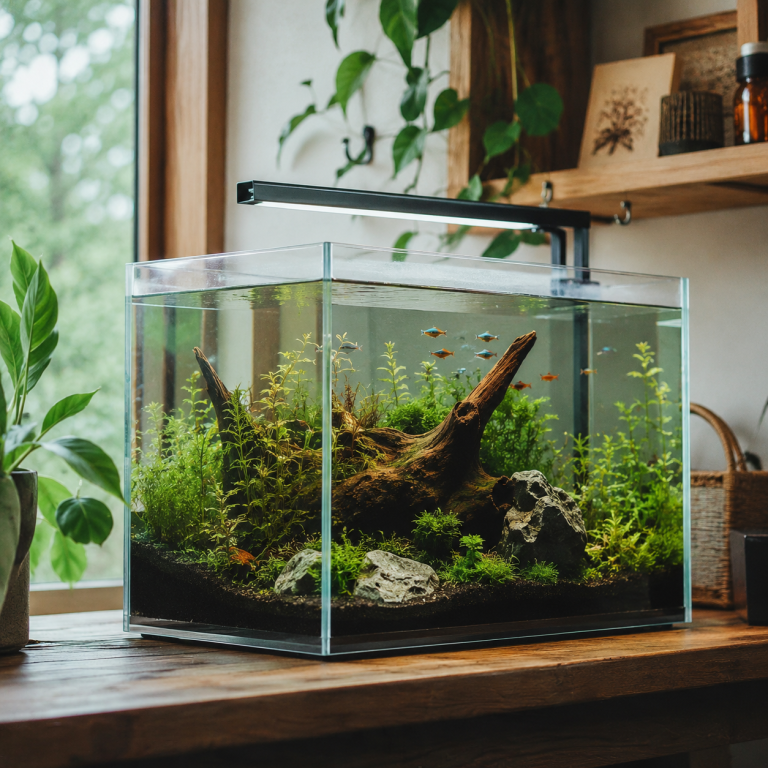
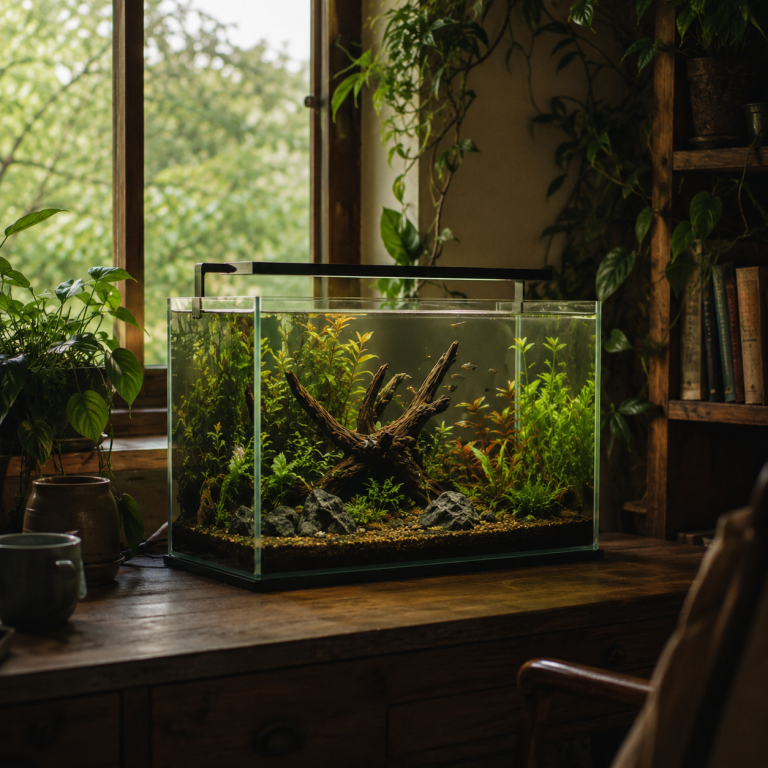
- 10 gallons: The sweet spot. Room for plants, hiding spots, stable parameters, and even a few carefully chosen tank mates.
- 15-20 gallons: Ideal if you want a community setup built around your betta.
Bigger is also easier. A 10-gallon tank forgives a missed water change; a 2-gallon punishes it with an ammonia spike by the weekend. For a new keeper, volume is insurance.
The Complete Betta Tank Setup Checklist
1. Heater (Non-Negotiable)
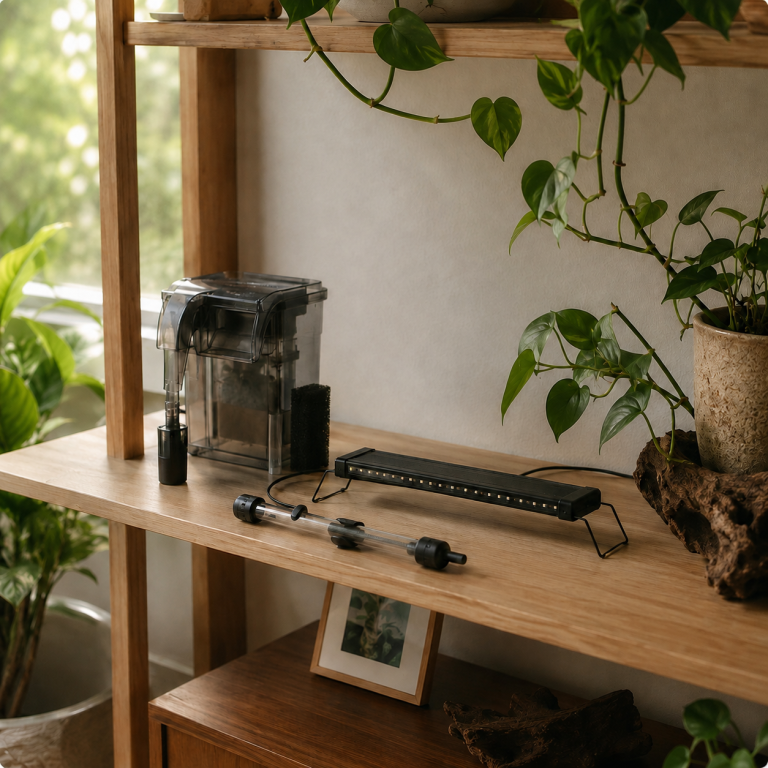
Bettas are tropical fish. At room temperature (68-72°F in most homes), their metabolism slows, their immune system weakens, and they become lethargic targets for disease. Keep water at a steady 76-82°F with an adjustable heater — 25W for a 5-gallon, 50W for a 10-gallon. Preset “betta heaters” with no thermostat are unreliable; an adjustable heater plus a separate thermometer is the dependable combo.
2. Gentle Filter
Bettas evolved in still water, and those flowing fins act like sails — strong filter flow exhausts them. Choose a filter you can turn down: a small hang-on-back with adjustable flow, or better yet, a sponge filter driven by an air pump. Sponge filters are cheap, nearly silent, biologically excellent, and produce zero current stress. Whatever you choose, the tank must be cycled before the fish goes in — an uncycled tank is the number one killer of new bettas.
3. Lid (Seriously)
Bettas jump. They’re surface-dwelling, air-breathing fish fully capable of launching themselves out of an open top, especially when startled. A lid with a small feeding gap is mandatory equipment, not an accessory.
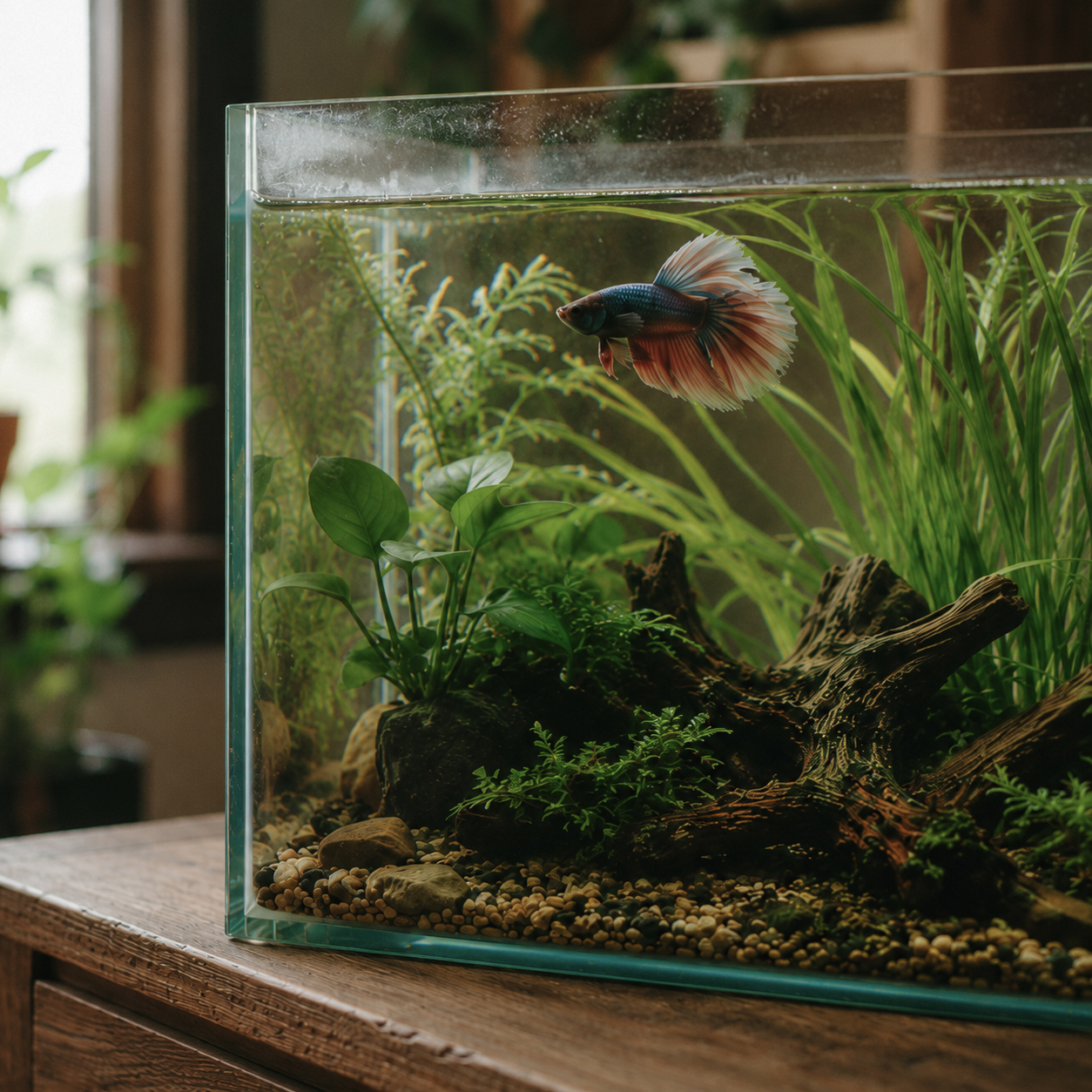
4. Substrate, Plants, and Hiding Spots
Bettas are intelligent, curious fish that explore and claim territory. A bare tank produces a bored, stressed fish. Provide:
- Live or silk plants — broad-leafed species like anubias and Java fern give bettas their famous “resting spots” near the surface. Avoid cheap plastic plants with sharp edges; they shred fins.
- A cave or two — a smooth resin cave, coconut hut, or terra-cotta pot on its side gives them a secure retreat.
- Dark substrate — bettas show their best color over dark sand or gravel, and it makes the tank feel more secure for them.
Run your finger along every decoration before it goes in. If it catches your skin, it will catch a betta’s fins.
5. Lighting
Nothing special required — a standard LED on an 8-10 hour timer keeps plants alive and gives your betta a day/night rhythm. Bettas have no eyelids; constant bright light is genuinely stressful for them.
Water Parameters and Maintenance
Bettas are hardy about chemistry but unforgiving about cleanliness. Target numbers:
- Ammonia: 0 ppm
- Nitrite: 0 ppm
- Nitrate: under 20 ppm
- Temperature: 76-82°F, stable
- pH: 6.5-7.5 (stability matters more than the exact number)
Weekly routine for a filtered 5-10 gallon betta tank:
- 25-30% water change with a gravel vacuum, removing debris from the substrate.
- Match the new water’s temperature — a 5°F swing shocks the fish. Use a thermometer, not your hand.
- Dechlorinate everything that touches the tank. Tap water chlorine burns gills.
- Test weekly with a liquid test kit (strips are unreliable). Rising nitrate tells you when to change more or feed less.
Skip the “100% water change” advice you may have heard — it destroys the beneficial bacteria that keep the tank safe. Partial, frequent changes are the correct method for any filtered tank.
What to Feed a Betta (and How Much)
Bettas are carnivores. In the wild they hunt insects and larvae at the surface — which is why quality betta pellets are meat-based and float.
The daily staple: a high-protein betta pellet (check the label — the first ingredients should be whole fish, krill, or insect meal, not wheat or fish meal filler). Feed 2-4 pellets once or twice a day. A betta’s stomach is roughly the size of its eye — the fish will always act hungry, and overfeeding is the most common beginner mistake. Uneaten food rots into ammonia.
Weekly variety (2-3 times a week):
- Frozen or freeze-dried bloodworms — the betta equivalent of steak night. Thaw frozen foods in a cup of tank water first.
- Brine shrimp or daphnia — excellent protein; daphnia also acts as a gentle laxative.
One fast day per week keeps digestion healthy and helps prevent bloating. If your betta’s belly looks swollen, skip food for 2-3 days and offer a small piece of blanched, de-shelled pea or daphnia before reaching for medication.
Can Betta Fish Live with Other Fish?
Sometimes — with the right tank, the right betta, and the right companions. Every betta has an individual personality; some tolerate tank mates calmly, others attack anything that moves. Always have a backup plan (a spare cycled tank or a divider) before trying.
Rules for betta community tanks:
- Minimum 15-20 gallons, heavily planted, with broken sightlines
- Never two males — they will fight to the death; it’s where the name “Siamese fighting fish” comes from
- No fin-nippers — tiger barbs and most danios will shred betta fins
- No flashy lookalikes — guppies’ flowing tails can trigger a betta’s aggression toward “rival males”
- Nothing large or boisterous — the betta must remain the calm center of the tank
Companions that usually work (in a big enough tank):
- Corydoras catfish — peaceful bottom-dwellers that ignore the betta entirely (keep 5+)
- Kuhli loaches — nocturnal, shy, and occupy a completely different zone
- Otocinclus — tiny algae grazers in a mature tank (3+)
- Nerite snails — the safest “tank mate” of all; excellent algae eaters with a shell a betta can’t harm
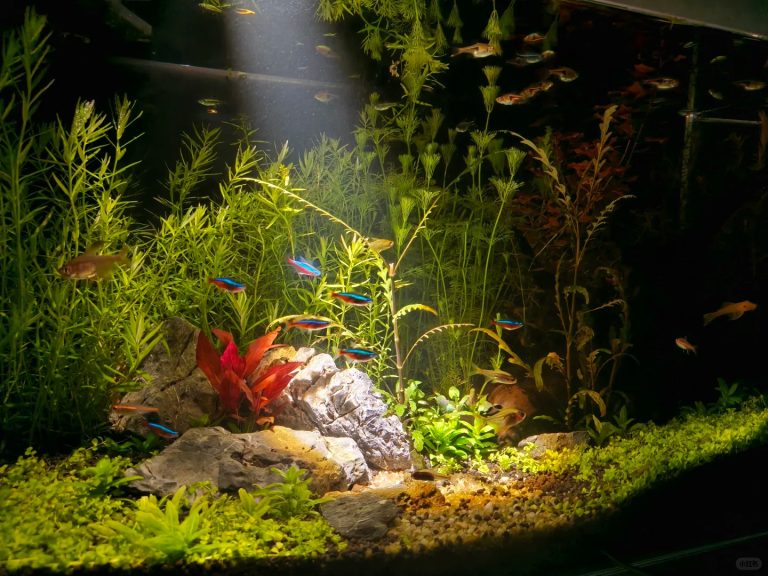
- Neon or ember tetras — possible in 20+ gallons with a calm betta; risky with a feisty one
Introduce tank mates after the betta has settled for a few weeks, rearrange the decor at introduction time to reset territories, and watch closely for the first 48 hours. Chasing briefly is normal; relentless pursuit or torn fins means the pairing has failed.
Common Betta Health Problems (and What to Do)
Fin Rot
Fins look ragged, discolored at the edges, or progressively shorter. Nearly always caused by dirty water. Fix the water first: daily 25% changes for a week usually stops mild cases without medication. Severe cases (rot reaching the fin base) need an antibacterial treatment in a hospital tank.
Ich (White Spot Disease)
White salt-like grains on body and fins, plus flashing (rubbing against objects). Raise the temperature gradually to 82-84°F to speed the parasite’s life cycle and treat with an ich medication according to the label. Treat the whole tank — ich lives in the water and substrate, not just on the fish.
Bloat and Swim Bladder Trouble
Swollen belly, trouble staying level, floating sideways or sinking. Usually overfeeding or low-quality dry food. Fast for 2-3 days, then offer daphnia. Prevent it with smaller, better meals — this one is almost always diet-related.
Lethargy and Clamped Fins
A betta sitting on the bottom with fins held tight against the body is telling you something is wrong. Check in order: temperature (too cold?), ammonia/nitrite (uncycled or crashed tank?), recent changes (new decor, new tank mates, moved tank?). The vast majority of “sick betta” cases trace back to cold or dirty water, not disease.
Popeye, Velvet, and Dropsy
Bulging eyes (popeye) and a gold-dust sheen (velvet) are treatable with quarantine and medication when caught early. A pinecone-raised scale appearance (dropsy) is a sign of organ failure — humane euthanasia is usually the kindest option. Prevention beats all three: clean, warm, stable water.
Choosing a Healthy Betta at the Store
Betta cups at chain stores are rough environments, so inspect carefully before you buy:
- Active and responsive — a healthy betta flares, swims to investigate you, or at minimum reacts to movement. A fish lying motionless on its side is a pass.
- Full, intact fins — some fin damage heals fine in clean water, but avoid fins that are blackened or bloody at the edges (active rot).
- Clear eyes and smooth body — no cloudiness, white spots, fuzzy patches, or raised scales.
- Belly shape — slightly rounded is good; swollen and pinecone-scaled is not; sunken suggests parasites.
- Bright, even color — stress stripes (horizontal lines) and washed-out color signal a fish under heavy stress.
One honest note: buying the sad-looking betta to “rescue” it is kind-hearted but risky for a first-timer — sick fish need experienced nursing. Start with a healthy specimen; learn the care basics; rescue later if you still want to.
Betta Tail Types: Does It Affect Care?
The care rules above apply to every betta, but tail type changes a few details:
- Veiltail — the classic long, drooping tail; the most common and affordable. Standard care applies; keep flow gentle.
- Halfmoon — a dramatic 180-degree fan tail. Gorgeous but heavy; these bettas rest more and need abundant leaf “hammocks” near the surface. More prone to fin-biting when bored.
- Crowntail — spiky, webbed-reduced fins. Striking and active; watch for fin curling in hard water.
- Plakat (short-fin) — the athletic, traditional fighting-fish shape. The most active and hardiest swimmers, tolerant of slightly more flow, and the best choice if you want a community tank attempt.
- Dumbo/elephant ear — oversized pectoral fins. Charming, but the extra fin weight means calmer water and more resting spots.
Rule of thumb: the longer the fin, the gentler the flow and the more resting spots required. If you’re unsure which to pick, a plakat or veiltail from a reputable breeder is the most forgiving first betta.
Your Betta Care Schedule at a Glance
| Frequency | Task |
|---|---|
| Daily | Feed 2-4 pellets (1-2 meals); check temperature reads 76-82°F; 30-second health glance at fins, belly, and behavior |
| Weekly | 25-30% water change with gravel vacuum; test ammonia, nitrite, nitrate; rinse sponge/filter media in old tank water; one fast day |
| Monthly | Scrape algae from glass; trim dead plant leaves; check heater and filter function; refresh/rearrange decor for enrichment |
| Every 2-3 days | Offer variety food (bloodworms, brine shrimp, or daphnia) in place of one pellet meal |
Total time commitment: about five minutes a day plus twenty minutes on the weekend. That’s the honest maintenance cost of a thriving betta.
Common Betta Myths, Busted
The betta aisle is where aquarium misinformation goes to thrive. Let’s clear up the big ones:
- “Bettas live in puddles, so small containers are fine.” They survive seasonal shallows by breathing air — an emergency adaptation, not a preference. Depth matters less than surface area, warmth, and clean water, none of which a cup or vase provides.
- “Bettas don’t need a heater because they’re hardy.” Hardiness means they endure bad conditions longer before dying — not that bad conditions are acceptable. Cold bettas are chronically stressed bettas.
- “A plant on top means you don’t need water changes.” The betta-in-a-vase-with-a-peace-lily setup fails on every front: the plant can’t process fish waste fast enough, and the betta can’t eat plant roots. Carnivore, remember?
- “Bettas are aggressive toward everything.” Males fight other male bettas. Toward most other species, a well-kept betta in a proper tank is usually peaceful — individual temperament permitting.
- “They only live a year anyway.” That statistic describes bettas in bowls. In heated, filtered tanks, 3-5 years is normal and longer isn’t rare.
Frequently Asked Questions
How long do betta fish live?
Three to five years in a heated, filtered, properly maintained tank. Most bettas sold in stores are already 6-12 months old. The fish that dies at eight months in a bowl wasn’t “old” — it was kept in conditions that shortened its life by years.
Can a betta live in a bowl without a filter?
Survive, sometimes. Thrive, no. An unfiltered bowl can’t hold beneficial bacteria, so ammonia from waste and uneaten food poisons the water constantly. Add cold room temperatures and the result is the classic listless bowl betta. A 5-gallon kit with a heater and sponge filter costs little and transforms the fish’s health, color, and personality.
Why is my betta making bubbles at the surface?
That’s a bubble nest — male bettas blow clusters of saliva-coated bubbles at the surface as part of their natural breeding instinct. It’s a sign of a healthy, comfortable, mature fish, though it doesn’t mean he needs a mate. Leave it alone; he’ll tend it proudly.
Do bettas get lonely or bored?
Lonely, no — they’re solitary by nature. Bored, absolutely. Bettas recognize their owners, learn feeding routines, and investigate anything new in their environment. Rearrange decor occasionally, offer varied foods, and interact at the glass — many bettas learn to follow a finger or flare on command.
Why did my betta’s color fade?
The common causes: cold water, poor diet, stress, or simply age and genetics (many pet-store bettas change color as they mature — the “marble” gene can transform them dramatically). If fading comes with lethargy or clamped fins, test your water and check the heater first.
How often should I clean a betta tank?
A 25-30% water change weekly for a filtered 5-10 gallon tank, with a light gravel vacuum. Never replace all the water at once, and never rinse filter media in tap water — swish it in old tank water during the change to preserve the bacteria doing your filtration.
The Bottom Line
Betta care isn’t complicated — it’s just different from the myths. Warm water (heater), clean water (filter + weekly changes), real space (5+ gallons), meaty food (small portions), and an enriched environment (plants, hides, a lid). Meet those five needs and you’ll have a fish with genuine personality that greets you at the glass every day for years. Get the tank right first — our step-by-step setup guide walks you through cycling — and the betta takes care of the rest.