Best 10 Gallon Aquarium Kits for Beginners (2026 Honest Reviews)
A 10 gallon aquarium kit is the most popular entry point into fishkeeping — big enough to be stable, small enough to fit on a desk. But starter kits vary wildly in quality, and the wrong one saddles you with a noisy filter, a dim light, and hidden upgrade costs. This guide reviews the best 10 gallon aquarium kits for beginners in 2026, what each one actually includes, and the honest shortcomings nobody prints on the box.
One thing before the picks: a kit gives you hardware, not a ready ecosystem. Every new tank must be cycled before fish go in — our complete freshwater aquarium setup guide walks through that process step by step. Buy the kit today, add fish in a few weeks, and everything goes better.
How We Evaluate Gear
A quick note on our review standards, since this is our first gear roundup: we evaluate equipment on the criteria that actually decide whether a beginner succeeds — filtration quality and upgrade path, noise (measured in a quiet room, because a tank you can hear becomes a tank you resent), light output relative to common beginner plants, build quality, availability of replacement parts, and total cost of ownership including the accessories the box doesn’t mention. We don’t accept placement fees, and no manufacturer previewed this guide. Where a kit has a genuine weakness, we say so — a review that praises everything helps no one.
Why 10 Gallons Is the Beginner Sweet Spot
5 gallon tanks are tempting — cheaper, cuter, everywhere. But here’s the counterintuitive truth of fishkeeping: smaller water volume means less stability, not less work. In a 5 gallon tank, one overfeeding can spike ammonia overnight; in a 10 gallon, the same mistake is diluted into a warning instead of a crisis.
Ten gallons also unlocks real stocking options: a proper school of 6-8 small tetras or rasboras, a betta with tank mates, or a livebearer trio — versus the “one betta, nothing else” constraint of smaller tanks. (Stocking ideas for every size are in our 15 best beginner fish guide.) And a 10-gallon still fits a dresser, desk, or kitchen counter at roughly 20 × 10 × 12 inches and about 110 lbs filled.
What to Look for in a Starter Kit
Every kit bundles the same four things in different quality tiers. Judge them on these:
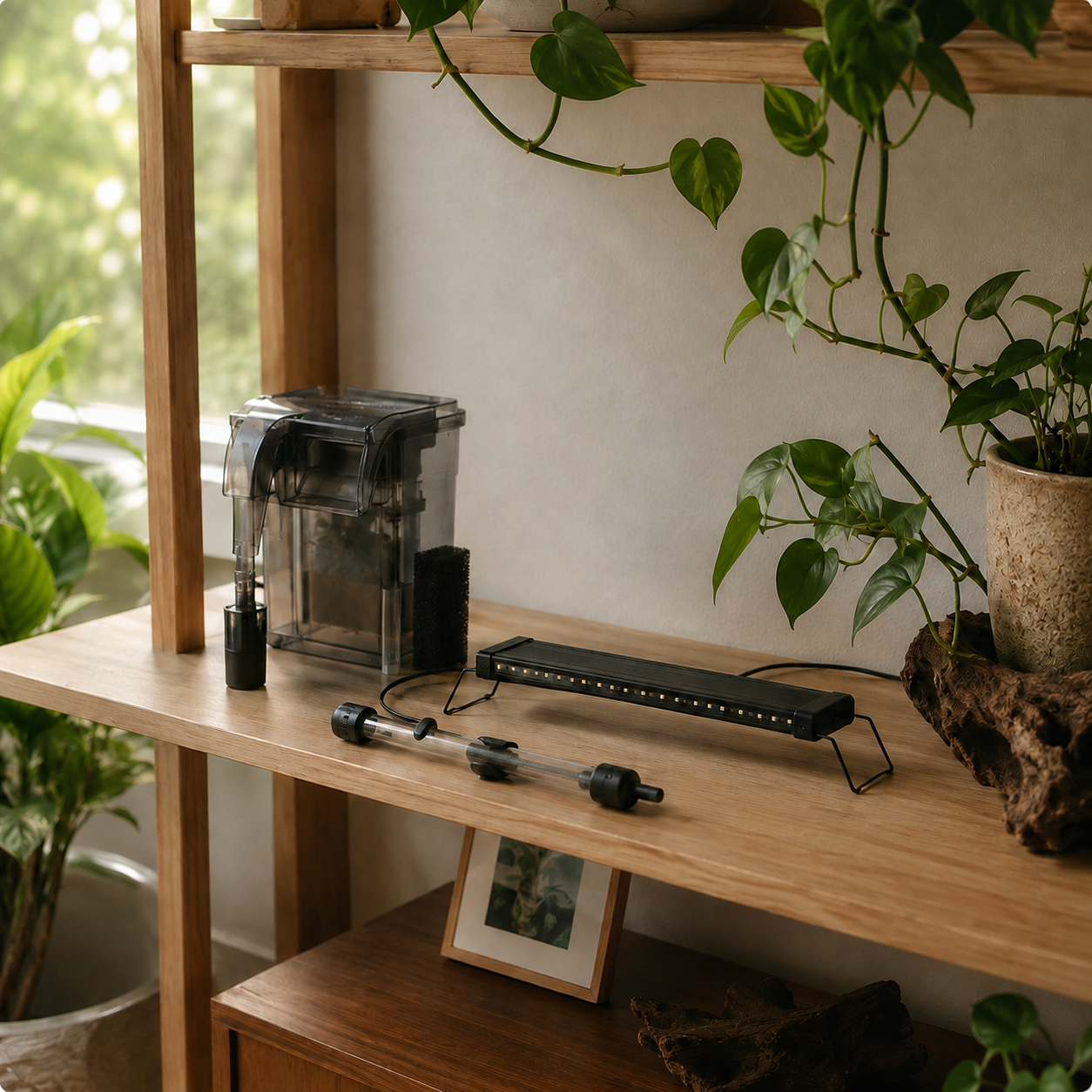
- The filter (most important): This is the heart of the tank. Look for a hang-on-back (HOB) filter with adjustable flow and room for your own media. Avoid kits whose only filtration is a flimsy internal “corner” filter you can’t upgrade.
- The light: Basic LED hoods are fine for fish-only tanks. If you want live plants, check for a full-spectrum LED — or budget for a better light later.
- The hood/lid: Full coverage matters. Fish jump, water evaporates, and cats are optimists. Hinged feeding doors are a nice quality-of-life touch.
- What’s NOT included: Almost no 10-gallon kit includes a heater (add $15-25), and none includes substrate, decor, water conditioner, or a test kit. Budget roughly $60-80 beyond the kit price for a complete setup.
The Best 10 Gallon Aquarium Kits for Beginners
1. Aqueon LED 10 Gallon Aquarium Kit — Best Overall
Includes: glass tank, low-profile LED hood, QuietFlow 10 HOB filter with cartridge, fish food and water conditioner samples, setup guide
The Aqueon kit earns the top spot by having no weak link. The QuietFlow 10 filter is a genuine HOB you can maintain and customize for years — it accepts standard cartridges or your own sponge/bio-media — and it runs quiet enough for a bedroom. The low-profile LED hood is bright, even, and has a clean modern look that doesn’t scream “beginner kit.”
Pros: reliable filter with upgrade path; bright low-profile LED; widely available; replacement parts easy to find.
Cons: no heater; stock cartridges push you toward proprietary refills (swap in generic sponge media and forget about them); light is fine for fish but marginal for demanding plants.
Best for: the classic first community tank — a school of small fish plus corydoras.
2. Tetra 10 Gallon Complete LED Kit — Best Value
Includes: glass tank, LED hood, Tetra Whisper 10i internal filter, heater (!), thermometer
Tetra’s kit is frequently the cheapest complete option — and it’s the rare one that includes a heater, which alone saves $15-25. The Whisper internal filter is silent (it lives up to the name) and gentle, which suits bettas and shrimp.
Pros: heater included; very quiet; often deeply discounted; gentle flow for long-finned fish.
Cons: the internal filter takes up tank space and is harder to customize than an HOB; the LED is the dimmest in this roundup — fine for viewing, weak for plants; build quality feels a step below Aqueon and Marina.
Best for: tight budgets and betta tanks where silence and gentle flow matter most.
3. Marina LED 10 Gallon Aquarium Kit — Best for First-Timers
Includes: glass tank, LED clip-on canopy light, Marina Slim S10 HOB filter, water conditioner and food samples, care guide
Marina (by Hagen/Fluval) builds the most beginner-proof package: clear instructions, a slim HOB filter that’s simple to service, and a bright clip-on LED that leaves the top open for easy access. The Slim S10 has adjustable flow and accepts Fluval-standard media — a real upgrade ecosystem behind it.
Pros: excellent instructions for absolute beginners; quality HOB with real media options; open-top light design makes feeding and planting easy.
Cons: no heater; the clip-on light looks less integrated than a full hood; evaporation runs higher without a full lid.
Best for: anyone who wants the gentlest learning curve and plans to add live plants.
4. Aqueon LED MiniBow 10 Kit — Best for Desks and Small Spaces
Includes: curved-front glass tank, elevated LED hood, QuietFlow internal filter
The MiniBow’s bowfront glass gives it a distinctive look that flatters a desk or shelf, and the elevated hood hides the light hardware cleanly. It’s the most “decor-friendly” kit here.
Pros: attractive curved front; compact footprint; quiet filtration; good viewing angles.
Cons: the curved glass slightly distorts viewing at the edges and is harder to scrape clean; internal filter occupies swimming space; no heater.
Best for: offices, bedrooms, and anyone who cares as much about looks as function.
5. Fluval SPEC V (5 Gallon) — Honorable Mention for Tight Spaces
Includes: etched-glass tank, 37-LED overhead lighting system, 3-stage filtration built into the rear chamber, pump
Not a 10 gallon — but if your space truly can’t fit one, the SPEC V is the best small tank money buys, and its all-in-one design (filter hidden in a rear chamber, sleek aluminum-trimmed light) embarrasses every cheap 5 gallon kit. The 3-stage filtration is genuinely good.
Pros: premium build; excellent hidden filtration; beautiful light; looks like a tank twice its price.
Cons: 5 gallon stocking limits (one betta, or a small shrimp colony — see our betta care guide for a proper setup); costs more than most 10 gallon kits; no heater included.
Best for: a desktop betta or shrimp showcase where space is the hard constraint.
Quick Comparison Table
| Kit | Filter Type | Heater | Light Quality | Best For |
|---|---|---|---|---|
| Aqueon LED 10 | HOB (QuietFlow 10) | No | Good | Best overall community tank |
| Tetra Complete LED 10 | Internal (Whisper 10i) | Yes | Basic | Best value / bettas |
| Marina LED 10 | HOB (Slim S10) | No | Good | Easiest first setup |
| Aqueon MiniBow 10 | Internal (QuietFlow) | No | Good | Desks and decor |
| Fluval SPEC V (5 gal) | Built-in 3-stage | No | Excellent | Tight spaces, betta/shrimp |
Should You Size Up to a 20 Gallon Instead?
If your space and budget allow it, a 20 gallon long is the one upgrade worth considering before you buy. Here’s the honest comparison:
- Stability: double the water volume means slower chemistry swings — even more forgiving than a 10 gallon.
- Stocking: a 20-long unlocks species that genuinely need more room — bristlenose plecos, honey gouramis, larger schools of corydoras, and active swimmers like zebra danios that appreciate the 30-inch length.
- Cost: 20 gallon kits run roughly $40-60 more, plus a stronger heater (100W) and more substrate.
- Space and weight: a filled 20-long weighs about 225 lbs and needs a dedicated stand or a verified-sturdy dresser; a 10 gallon sits safely on most solid furniture.
Our advice: if the tank is going on a desk, shelf, or in a kid’s room, buy the 10 gallon with confidence — it’s a size you’ll never outgrow for bettas, small schools, and shrimp. If it’s going on a dedicated stand in the living room and you can stretch the budget, the 20-long is the tank you won’t wish you’d bought a year from now. Either way, the kits above represent the best starting point at their size.
What No Kit Includes (Budget for These)
The sticker price is never the whole price. Every kit on this list still needs:
- Heater ($15-25) — a 50W adjustable heater for tropical fish; skip this only for cool-water setups like white cloud minnows
- Substrate ($10-15) — 10 lbs of gravel or sand for a 10 gallon; sand if you want corydoras or kuhli loaches
- Water conditioner ($8) — dechlorinates tap water; a single bottle lasts a year
- Liquid test kit ($25-35) — non-negotiable for cycling and weekly checks; the API Freshwater Master Test Kit is the hobby standard
- Decor and plants ($15-40) — hiding spots reduce fish stress measurably; a cave plus a few easy plants (anubias, Java fern) is plenty
- Thermometer ($5) — verify the heater is doing its job, don’t trust the dial
Total realistic all-in cost: $130-200 depending on kit choice. Anyone promising a complete setup for $40 is selling you the tank and hiding the rest.
Setting Up Your Kit: The Right Order
- Position the tank on a level, sturdy surface away from direct sun and drafts — before adding water. A filled 10 gallon weighs over 100 lbs and should never be moved wet.
- Rinse substrate until the water runs clear, add 1.5-2 inches, then decor.
- Fill slowly with dechlorinated water (pour onto a plate to avoid disturbing the substrate), then install filter, heater, and thermometer — but don’t plug the heater in until it’s fully submerged for 15 minutes.
- Start the nitrogen cycle. This takes 2-6 weeks and is the step that determines whether your first fish live or die. Follow the fishless cycling method in our setup guide — patience here is the whole game.
- Stock gradually. When ammonia and nitrite read zero after a full dose of ammonia is processed within 24 hours, add your first small group — one school or one centerpiece fish, then wait two weeks before adding more.
Common Kit-Buying Mistakes to Avoid
- Buying fish the same day as the kit. The single most common beginner disaster. The tank needs weeks to cycle; the fish store will still be there.
- Choosing by the fish you saw at the store. Pick the tank first, cycle it, then choose fish that fit — not the reverse.
- Trusting “self-cleaning” claims. No kit is maintenance-free. Every tank needs weekly 25% water changes, forever.
- Over-filtering flow for long-finned fish. A powerful filter on a betta tank is cruelty; choose adjustable flow or a sponge filter.
- Skipping the test kit. You cannot see ammonia. Guessing water quality by “the tank looks clean” kills more beginner fish than any disease.
When to Upgrade Kit Components (and When Not To)
Kit gear gets a worse reputation than it deserves. Upgrade only when there’s a real reason:
- Filter: keep the stock HOB unless it’s genuinely failing. The highest-value “upgrade” is internal — replace disposable cartridges with a coarse sponge and a bag of ceramic bio-media. Total cost under $10, better filtration for years.
- Light: upgrade only if you move into demanding plants. For fish and easy plants, stock LEDs are fine. When you do upgrade, a full-spectrum bar light ($40-60) transforms plant growth overnight.
- Heater: the one component worth buying well from day one — a failed heater is the most common equipment killer of fish. A reliable adjustable 50W heater with an external thermometer is cheap insurance.
- Hood: replace only if it breaks or if you go open-top with a bar light. Functionally, stock hoods do their job.
The pattern: spend on heating and testing first, filtration media second, lighting only when plants demand it. Never upgrade something that works just because a forum said so.
Frequently Asked Questions
How long does a starter kit last before I need to replace it?
The tank itself, decades — glass doesn’t wear out. Expect to replace heater every 3-5 years, light LEDs dim over 5+ years, and filter impellers occasionally (a $10 part, not a new filter). A good kit is a long-term platform you maintain, not a disposable product.
Can I use a 10 gallon kit for saltwater?
Technically yes, but we don’t recommend it as a first saltwater tank — nano reefs are the hardest mode of the hardest branch of the hobby. Master freshwater first; a 10 gallon freshwater community teaches you 90% of what a reef will demand, at a tenth of the cost per mistake.
Is a 10-gallon tank good for beginners?
It’s the best size for most beginners: large enough to forgive small mistakes and hold a real community, small enough to fit anywhere and afford. The only reason to go smaller is hard space constraints; the only reason to go bigger is if you already know you want larger fish.
How many fish can live in a 10 gallon tank?
A good rule for small species: one school of 6-8 fish under 2 inches (neons, ember tetras, white clouds), or a betta plus 3-4 bottom dwellers, or a trio of platies. Stock gradually and let your test kit — not a formula — tell you when there’s room for more.
Do I need to replace the filter that comes with the kit?
Usually no — the HOB filters in the Aqueon and Marina kits are keepers. What you should replace is the cartridge mindset: swap proprietary cartridges for a sponge plus bio-media that you rinse in old tank water instead of throwing away monthly. Better biology, lower cost.
Can a 10-gallon kit grow live plants?
Easy plants, yes — anubias, Java fern, Java moss, and cryptocorynes grow under any of these kit LEDs with zero extra equipment. Demanding carpet plants and red stems need stronger light and usually CO2; that’s a year-two upgrade, not a day-one requirement.
How much does it cost to run a 10-gallon tank monthly?
Roughly $3-6 in electricity (heater is the main draw), plus food and occasional water conditioner — under $10/month total for most setups. The hobby’s real cost is the startup, not the upkeep.
The Bottom Line
For most beginners, the Aqueon LED 10 is the kit to buy: the best filter-to-price ratio and no fatal flaws. On a tight budget, the Tetra Complete with its included heater is unbeatable value. If you want the gentlest first experience, go Marina. Whichever you choose, remember that the kit is just the container — the cycle, the patience, and the weekly water changes are what actually keep fish alive. Start with our step-by-step setup guide, pick your fish from the beginner-proof list, and you’ll skip the mistakes that end most first tanks.