15 Best Freshwater Fish for Beginners
Choosing your first fish is the most exciting — and most dangerous — moment in fishkeeping. Pick wrong and you’ll spend months fighting aggression, disease, and water problems. This guide covers the 15 best freshwater fish for beginners: hardy, peaceful, widely available species that forgive the mistakes every new aquarist makes.
Before we dive in, one golden rule: even the hardiest fish will not survive an uncycled tank. If you haven’t completed the nitrogen cycle yet, read our complete freshwater aquarium setup guide first — it walks you through cycling step by step. Fish come after the bacteria, always.
How We Chose These 15 Fish
Every species on this list passes five tests:
- Hardiness — tolerates the parameter swings that happen in new tanks
- Peaceful temperament — won’t terrorize tankmates in a community setup
- Reasonable adult size — no “2-inch store fish that becomes a 12-inch monster”
- Easy feeding — accepts ordinary flakes and pellets, no live-food demands
- Wide availability — you can find healthy specimens at almost any fish store
For each fish you’ll find adult size, preferred temperature, minimum tank size, and honest notes on behavior — including the catches nobody tells you at the store.
1. Guppy (Poecilia reticulata)
Size: 1.5-2.5 inches · Temp: 74-80°F · Min. tank: 10 gallons
If one fish defines “beginner friendly,” it’s the guppy. Cheap, colorful, endlessly active, and tolerant of a wide range of water conditions. Males sport spectacular tails; females are larger and plainer. Guppies spend their days cruising every level of the tank, which makes a new setup feel alive immediately.
The catch: they breed relentlessly. Keep only males, or accept that a mixed group becomes fifty fish within months. Also avoid fancy long-finned strains in tanks with strong filter flow — those tails are sails.
2. Platy (Xiphophorus maculatus)
Size: 2-3 inches · Temp: 70-78°F · Min. tank: 10 gallons
Platies are the guppy’s sturdier cousin: stockier, arguably hardier, and available in reds, oranges, and sunset patterns that look painted. They’re calm community citizens that get along with everything on this list.
The catch: same livebearer breeding situation as guppies. They’re also enthusiastic eaters — don’t let their begging convince you to overfeed.
3. Zebra Danio (Danio rerio)
Size: 2 inches · Temp: 64-75°F · Min. tank: 10 gallons
The zebra danio is nearly indestructible — it’s the fish researchers use in labs precisely because it survives almost anything. Zippy, striped, and constantly in motion, it tolerates cooler water than most tropicals, making it perfect for unheated tanks in heated homes.
The catch: their speed is stressful for slow, long-finned tankmates. Keep them in groups of 6+ — a lone danio becomes a nippy, anxious danio.
4. Neon Tetra (Paracheirodon innesi)
Size: 1.5 inches · Temp: 72-78°F · Min. tank: 10 gallons
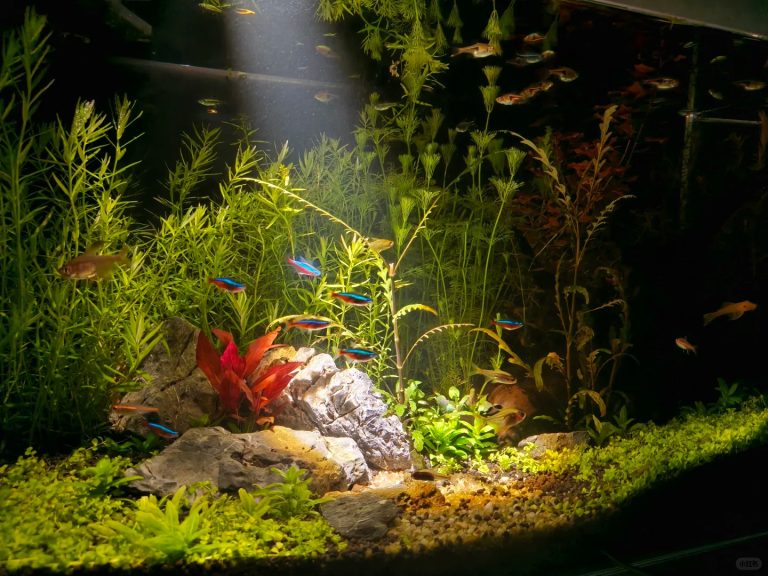
The iridescent blue-and-red stripe of a neon tetra school is the image most people picture when they imagine an aquarium. A school of 8-10 moving as one is genuinely mesmerizing, and they stay small forever.
The catch: neons are mass-farmed and can arrive weakened. Buy from a store whose tanks look clean and active, quarantine if you can, and never add them to a brand-new tank — wait until yours has run stable for a month or two. They must live in groups of 6 or more.
5. Corydoras Catfish (Corydoras species)
Size: 2-3 inches · Temp: 72-78°F · Min. tank: 15 gallons
Corydoras are the charming janitors of the substrate — armored, whiskered little catfish that spend their days sifting sand for leftover food and doing an adorable eye-wiggle. Bronze, albino, and panda cories are the easiest to find.
The catch: they’re social to the core. A lone cory is a stressed, hiding cory — keep 5 or more. And use sand or smooth, rounded gravel; sharp substrate wears down the barbels they feed with.
6. Betta Fish (Betta splendens)
Size: 2.5-3 inches · Temp: 76-82°F · Min. tank: 5 gallons (10 better)
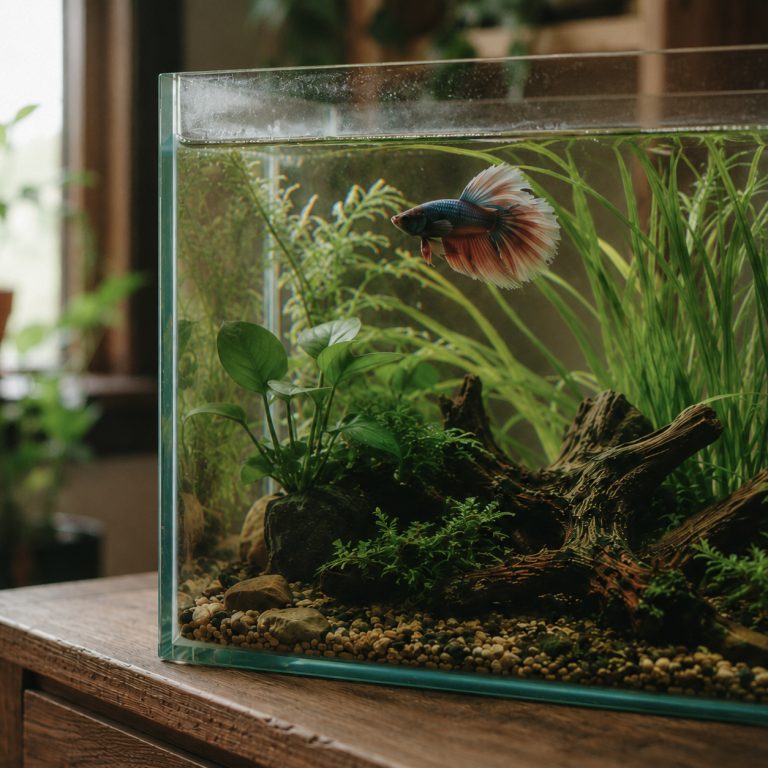
The betta is a jewel with a personality: flowing fins, jewel-tone colors, and enough curiosity to learn your face and beg at the glass. A single betta in a heated, filtered 10-gallon planted tank is one of the most rewarding beginner setups in the hobby.
The catch: despite the pet-store cup display, bettas need heaters and filters like any tropical fish. Males fight other males to the death, and flowy fins make them targets for fin-nippers like tiger barbs. One male per tank, gentle filter flow, warm water — non-negotiable.
7. Cherry Barb (Puntius titteya)
Size: 2 inches · Temp: 73-79°F · Min. tank: 15 gallons
Think barbs are all fin-nippers? The cherry barb is the gentle exception. Males flush a deep cherry red when showing off, and the species is calm enough to mix with shrimp and timid community fish. They’re shy at first, so give them plants and cover.
The catch: keep a mixed group (6+) with more females than males — outnumbered females get harassed during spawning behavior.
8. Harlequin Rasbora (Trigonostigma heteromorpha)
Size: 2 inches · Temp: 73-80°F · Min. tank: 10 gallons
The harlequin rasbora is what many aquarists wish neon tetras were: just as beautiful in a school (copper-orange body, black triangular patch), but significantly tougher and longer-lived. A school of 8+ is a quiet, elegant presence in a planted tank.
The catch: honestly, very few. They’re as close to a perfect community schooling fish as exists. Just keep the group size up and the water clean.
9. White Cloud Mountain Minnow (Tanichthys albonubes)
Size: 1.5 inches · Temp: 60-72°F · Min. tank: 10 gallons
Want a tank without a heater? The white cloud is your fish — a cool-water species that thrives at room temperature, with subtle red fins and a horizontal stripe that shimmers in good light. Hardy, peaceful, and criminally underrated.
The catch: they’re miserable in warm tropical tanks long-term. Pair with other cool-water species (like zebra danios), not with heat-lovers like bettas.
10. Bristlenose Pleco (Ancistrus species)
Size: 4-6 inches · Temp: 73-80°F · Min. tank: 20 gallons
Here’s the truth the fish store won’t tell you: the “common pleco” sold as an algae eater grows to 18 inches and belongs in a pond. The bristlenose pleco is the one you actually want — stays under 6 inches, genuinely grazes algae all day, and sports charming facial bristles (on males).
The catch: “algae eater” doesn’t mean “eats only algae.” Supplement with sinking wafers and blanched zucchini, and give it driftwood to rasp on — it’s part of their digestion.
11. Swordtail (Xiphophorus hellerii)
Size: 3-4 inches · Temp: 72-79°F · Min. tank: 20 gallons
Swordtails bring motion and color to the upper half of the tank — streamlined bodies, males trailing a dramatic “sword” extension from the tail. They’re active swimmers that appreciate longer tanks with open water.
The catch: another livebearer (breeding warning applies), and males can squabble — either keep one male with females or a larger group to spread aggression.
12. Molly (Poecilia sphenops)
Size: 3-4.5 inches · Temp: 75-80°F · Min. tank: 20 gallons
Mollies are the tanks of the livebearer world: robust, adaptable, and tolerant of harder, more alkaline water that fussier fish dislike. Black mollies look striking against green plants; dalmatian and balloon varieties offer personality.
The catch: they’re waste factories relative to their size — overstock mollies and your filter will know. They also appreciate slightly alkaline water (pH 7.5+), so they’re not ideal companions for soft-water species like neons.
13. Otocinclus (Otocinclus affinis)
Size: 1.5-2 inches · Temp: 72-79°F · Min. tank: 10 gallons
The “oto” is a tiny, gentle algae-grazing catfish that works like a Roomba for plant leaves and glass. They’re the only algae eater appropriate for small tanks, and a group of them quietly scours surfaces all day.
The catch: they’re wild-caught and can arrive starved. Only add otos to a mature tank (3+ months old) with real algae growth, keep 3+, and supplement with algae wafers. In a sterile new tank, they slowly starve.
14. Kuhli Loach (Pangio kuhlii)
Size: 3-4 inches · Temp: 75-82°F · Min. tank: 20 gallons
Half eel, half noodle of pure charm — the kuhli loach slithers through substrate and squeezes under decor with its striped, snake-like body. They’re completely peaceful, endlessly entertaining at dusk, and great scavengers.
The catch: they’re nocturnal and shy. You may not see them much at first; a group of 5+ with sand substrate and plenty of hiding spots builds their confidence to explore during the day.
15. Honey Gourami (Trichogaster chuna)
Size: 2-2.5 inches · Temp: 74-82°F · Min. tank: 10 gallons
The honey gourami rounds out our list as the perfect “centerpiece” fish for a small tank: a warm sunset-gold color, gentle temperament, and the gourami family’s trademark curious, deliberate movements. They have a labyrinth organ that lets them breathe air, so they tolerate low-oxygen water other fish can’t.
The catch: males in breeding mood turn deep red-orange and can get territorial. One per small tank, or a proven pair in 20+ gallons with dense planting.
How to Pick a Healthy Fish at the Store
Buying the right species is only half the job — you also need the right individual. Spend five minutes observing before you point at a tank:
- Active and alert — healthy fish swim purposefully and react when you approach. Avoid any fish sitting on the bottom, gasping at the surface, or clamping its fins against its body.
- Clear eyes and intact fins — cloudy eyes, white spots (ich), frayed or reddened fins, and cottony patches are all walk-away signs.
- Full belly, not sunken — a pinched, hollow-looking stomach often means parasites or a fish that hasn’t been eating. A slightly rounded belly is what you want.
- Check the whole tank, not just your fish — if any tankmate in the same system looks sick or there are dead fish in the corner, everything in that tank has been exposed. Come back another day.
- Ask when the shipment arrived — fish are most fragile in the first 48 hours after shipping. A store that quarantines new arrivals before selling them is a store worth your loyalty.
Quick Reference: The 15 Best Beginner Fish at a Glance
Short on time? This table summarizes everything above. Print it before your next fish store trip.
| Fish | Adult Size | Temp (°F) | Min. Tank | Group Size |
|---|---|---|---|---|
| Guppy | 1.5-2.5″ | 74-80 | 10 gal | 3+ |
| Platy | 2-3″ | 70-78 | 10 gal | 3+ |
| Zebra Danio | 2″ | 64-75 | 10 gal | 6+ |
| Neon Tetra | 1.5″ | 72-78 | 10 gal | 6+ |
| Corydoras Catfish | 2-3″ | 72-78 | 15 gal | 5+ |
| Betta Fish | 2.5-3″ | 76-82 | 5-10 gal | 1 male |
| Cherry Barb | 2″ | 73-79 | 15 gal | 6+ |
| Harlequin Rasbora | 2″ | 73-80 | 10 gal | 8+ |
| White Cloud Minnow | 1.5″ | 60-72 | 10 gal | 6+ |
| Bristlenose Pleco | 4-6″ | 73-80 | 20 gal | 1 |
| Swordtail | 3-4″ | 72-79 | 20 gal | 3+ |
| Molly | 3-4.5″ | 75-80 | 20 gal | 3+ |
| Otocinclus | 1.5-2″ | 72-79 | 10 gal | 3+ |
| Kuhli Loach | 3-4″ | 75-82 | 20 gal | 5+ |
| Honey Gourami | 2-2.5″ | 74-82 | 10 gal | 1-2 |
Popular Fish Beginners Should Avoid (For Now)
The fish store’s “freshwater” section is full of species that look beginner-sized but aren’t beginner-appropriate. Steer clear of these until you have more experience:
- Common pleco — sold at 2 inches as an “algae eater,” grows to 18 inches and out-produces the waste of every other fish in your tank combined. Choose a bristlenose instead.
- Goldfish (in tropical community tanks) — wonderful fish, wrong setup. They need cool water, heavy filtration, and far more space than their pet-store bowl suggests. A fancy goldfish wants 20 gallons for the first fish alone.
- Tiger barbs — colorful, cheap, and notorious fin-nippers. They will shred a betta’s fins and harass anything slow-moving. Only safe in large, species-focused groups.
- Oscars and other large cichlids — the adorable 2-inch oscar at the store becomes a 12-inch, 55-gallon-minimum predator with a personality. Fantastic fish, terrible first fish.
- African cichlids (mbuna) — require hard, alkaline water, rockwork, and deliberate overstocking strategies. A specialized setup, not a community-tank resident.
- Glassfish and “dyed” fish — any fish sold with artificial coloring (“painted” tetras, jellybean parrots) has been injected or dipped in dye, a cruel practice that shortens its life. Vote with your wallet.
- Discus — the “king of the aquarium” demands pristine, warm, soft water and near-daily maintenance. A magnificent goal fish for year two or three — not month one.
How to Acclimate New Fish (The Step Everyone Skips)
You’ve picked your fish — now don’t kill them in the parking lot. Water chemistry shock on the trip home and during introduction is a top-three killer of new fish. Here’s the method that works:
- Dim the lights. Turn off the tank light before the fish come home. Bright light adds stress to an already stressed animal.
- Float the bag 15-20 minutes. This equalizes temperature only — nothing else. Do not open it yet.
- Drip or cup acclimate. Open the bag, roll down the edges, and add a small cup of tank water every 5 minutes for 20-30 minutes. (A length of airline tubing set to a slow drip is even better.) This gradually matches pH and hardness.
- Net the fish out. Lift the fish from the bag with a net and release it into the tank. Never pour store water into your aquarium — it’s the easiest way to import disease.
- Leave the lights off for a few hours and skip the first feeding. Let them settle; most fish won’t eat on day one anyway, and uneaten food fouls the water.
One more tip: quarantine new arrivals for two weeks in a separate small tank whenever possible. It feels like overkill until the day it saves your entire established community from ich.
Building Your First Community: Stocking Guidelines
Fifteen great fish doesn’t mean fifteen fish in your tank. A balanced beginner community picks from three zones:
- Top/middle dwellers (schooling): guppies, platies, danios, tetras, rasboras — pick one schooling species, 6-10 individuals
- Bottom dwellers: corydoras or kuhli loaches — a group of 5
- Accent/utility: a bristlenose pleco, a honey gourami, or a betta (solo) as the “personality” fish
A proven first community for a 20-gallon tank: 8 harlequin rasboras + 5 panda corydoras + 1 honey gourami. Peaceful, colorful, active at every level, and forgiving of beginner mistakes. Add them over 4-6 weeks, not all at once.
For a 10-gallon tank: 1 betta + 3 otocinclus (in a mature tank), or 6 white cloud minnows + 3 corydoras in a cooler setup.
Frequently Asked Questions
How many fish can I put in my tank?
Forget “one inch per gallon” — it fails for anything beyond tiny fish. Better approach: stock gradually (a small group every 2 weeks), test your water, and let 0 ammonia / 0 nitrite be your green light to add more. A lightly stocked tank always looks better and lives longer than a packed one.
What’s the single easiest fish for a total beginner?
For a community tank, the zebra danio — nearly unkillable. For a solo showcase, a betta in a heated, filtered 10-gallon. Both forgive the mistakes that kill more delicate species.
Can I mix fish from this list freely?
Mostly yes, with three cautions: match temperature ranges (don’t pair cool-water white clouds with heat-loving bettas), respect group minimums (schooling fish kept singly become aggressive or sickly), and remember that big mouths eat small tankmates — adult mollies and swordtails can snack on newborn shrimp and tiny fry.
Why did my hardy beginner fish die in the first week?
In nine cases out of ten: the tank wasn’t cycled, or the fish was never acclimated. New tank syndrome kills more fish than any disease. Test ammonia and nitrite daily for the first month, and review the cycling section of our aquarium setup guide if the numbers aren’t zero.
Do I need a quarantine tank?
For your very first stocking, no. For every addition after that, ideally yes — even a simple 10-gallon with a sponge filter. Two weeks of quarantine prevents the heartbreak of one new fish introducing ich to an established tank.
The Bottom Line
The best beginner fish share a trait no store label mentions: they give you room to learn. Start with hardy schools like rasboras or danios, anchor the bottom with corydoras, and add personality with a betta or gourami. Keep groups together, temperatures matched, and stock slowly — and the fish on this list will still be with you years from now, long after the “beginner” label no longer applies to you.